
LEXTANT X SCAD
The Ideal Experience
In a semester-long contextual research study guided by Lextant’s Ideal Experience framework, our team of six explored a central question: What is the ideal experience of toys and play for adults?
Through user-centered research methodologies, including observation, in-depth interviews, sensory cue exercises, and survey data, we translated emotional narratives into a structured experience model.

CONTEXT
While play is often associated with childhood, adults continue to seek moments of immersion, connection, and expression.
Our objective was not to design a toy, but to define the experiential qualities that make play meaningful in adulthood. Our team did this by following Lextant's Contextual Research framework to collect qualitative user data.
METHODS USED:
-
Contextual observation
-
Online surveys
-
In-depth interviews
-
Sensory cue mapping
-
Affinitization workshops
-
Ideal Experience framework translation


FROM AFFINITIZATION TO FRAMEWORK
Through iterative affinitization, we distilled over 750 qualitative, primary data inputs into a central framework that visualizes the ideal experience of toys and play.
The resulting framework translates emotional and sensory data into a tiered model, allowing brands to evaluate whether a play experience aligns with adult experiential expectations.


Project Role
User Researcher & Visual Designer
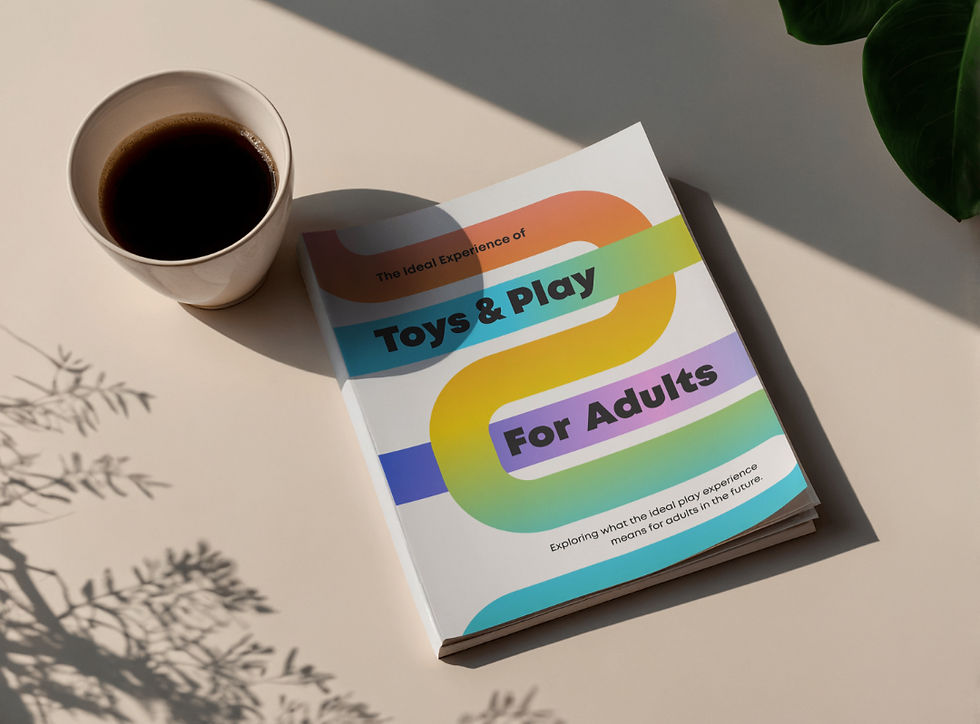
I contributed across all research phases, including interviews, observation, and synthesis workshops. Additionally, I played a leading role in translating insights into a cohesive visual framework and designing the final client book, including creative direction and graphic design.
PROCESS DECK
CLICK TO EXPAND